
Files
Download Full Text (513 KB)
Description
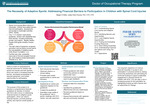
Children with spinal cord injuries (SCI) face significant financial barriers that limit access to adaptive sports, despite the physical and psychosocial benefits of participation. This capstone project aimed to address this gap by developing a comprehensive financial resource guide for families. Guided by the Person-Environment-Occupation-Performance (PEOP) model, a needs assessment was conducted through semi-structured interviews, clinical observations, and stakeholder input, revealing a lack of accessible and centralized funding information. In response, a guidebook was created that includes educational content, local and national funding opportunities, and practical tools for navigating financial aid and grant applications. The guide was piloted and refined based on community feedback. This project highlights the role of occupational therapy in addressing social determinants of health (SDOH) and promoting equitable access to meaningful occupations. By improving access to financial resources, this project aims to increase participation in adaptive sports and enhance overall quality of life for children with SCI.
Publication Date
Spring 4-8-2026
Publisher
University of St. Augustine for Health Sciences
Keywords
Children, Spinal cord injuries, Adaptive sports, Needs assessment, Feedback, Occupational therapy, Social determinants of health, Occupations, Quality of life, Financial barriers
Medical Subject Headings
Children, Spinal cord injuries, Adaptive sports, Needs assessment, Feedback, Occupational therapy, Social determinants of health, Occupations, Quality of life, Financial barriers
Disciplines
Medicine and Health Sciences | Occupational Therapy
Recommended Citation
Wells, M. G., & Khan-Farooqi, L. (2026, April 8). The Necessity of Adaptive Sports: Addressing Financial Barriers to Participation in Children with Spinal Cord Injuries. Poster presented at the Virtual OTD Capstone Symposium, University of St Augustine for Health Sciences. Retrieved from https://soar.usa.edu/otdcapstonesspring2026/33

Comments
Poster presented at the OTD Capstone Symposium held at the University of St. Augustine for Health Sciences on April 8-23, 2026.