

Files
Download Full Text (283 KB)
Description
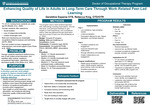
Younger adults residing in long-term care (LTC) institutions face numerous challenges related to identity, engagement, social interactions, mental health, and overall quality of life. This doctoral capstone project developed and implemented a peer-led, work-related intervention program designed to promote mental health, enhance occupational engagement, and improve the quality of life for younger adults residing in long-term care facilities. A 14-week program, comprising an occupational profile, needs assessment, role selection, and two trials of peer-led meaningful work activities, was completed by five participants, aged 29 to 63. The Model of Human Occupation (MOHO) served as the foundation for a qualitative program evaluation methodology. Results indicated an improvement with PHQ-9 scores decreasing across all participants and WHOQOL-BREF scores increasing. Participants demonstrated greater confidence, social interaction, purpose, and self-identity through engagement in work-related leadership roles. Significant improvements were noted between the first and second trials in observations and feedback, including increased independence, smoother sessions, improved peer communication, and stronger group dynamics. The program demonstrated that peer-led occupational engagement can transform the LTC environment into a meaningful community for younger residents, despite obstacles such as varying health conditions, staffing limitations, pain levels, and limited access to materials, which can influence implementation. This program highlights the vital role of occupational therapy in alleviating occupational deprivation and increasing engagement, identity, and well-being in younger LTC populations. Moving forward, this program can benefit residents in LTC across all ages, and the integration of peer-led work programs offers possible future directions for continued development and an increased sense of community and belonging.
Publication Date
Fall 2025
Publisher
University of St. Augustine for Health Sciences
Keywords
Autonomy, Social engagement, Occupational deprivation, Belonging, Act of doing
Medical Subject Headings
Quality of Life, Mental health, Peer-led, Work roles
Disciplines
Medicine and Health Sciences | Occupational Therapy
Recommended Citation
Esparza, G., & King, R. (2025, October 1). Enhancing Quality of Life in Adults in Long-Term Care Through Work-Related Peer-Led Learning. Poster presented at the Virtual OTD Capstone Symposium, University of St Augustine for Health Sciences. Retrieved from https://soar.usa.edu/otdcapstonesfall2025/1

Comments
Poster presented at the OTD Capstone Symposium at the University of St Augustine for Health Sciences in Fall 2025.