
Files
Download Full Text (1.8 MB)
Description
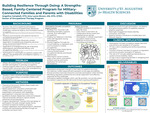
Resilience is often conceptualized as an individual trait that someone is born with or an outcome; however, this capstone project examined resilience as a dynamic process developed through participation in meaningful occupations within family contexts. This project explored the experiences of military-connected families and parents with disabilities to understand how contextual factors influence participation and adaptive capacity. A participation- and strength-based, family-centered intervention was developed and implemented with the school’s pro bono clinic, integrating principles of occupational therapy, including occupational adaptation and client-centered practice.
Findings indicated that resilience emerged through repeated engagement in meaningful activities, supported by relational safety, identity development, and opportunities for real-time adaptation. Systemic barriers, including institutional mistrust, accessibility challenges, and environmental instability, significantly impacted participation and required families to engage in substantial invisible labor. Interventions emphasizing experiential engagement, co-regulation, strengths-based reflection, including use of a visual tree-based tool adapted from the Model of Human Occupation (MOHO), were perceived as more meaningful and effective than discussion-based approaches. These findings informed the development of Campbell’s Application of Resiliency to Occupational Therapy (CAROT), a conceptual model illustrating resilience as an emergent outcome of sustained, participation-driven adaptation within dynamic contexts. This model positions participation as the primary mechanism through which adaptive response, occupational identity, and self-efficacy are developed and reinforced over time. This project highlights the role of occupational therapy in supporting resilience, not as a skill to be taught, but as a capacity developed through engagement in everyday life.
Publication Date
Spring 4-20-2026
Publisher
University of St. Augustine for Health Sciences
Keywords
Occupational Therapy, resilience, participation-focused, family-centered, strengths-based, occupational identity, occupational adaptation, MOHO, Kawa, military connected families, parents with disability
Medical Subject Headings
Occupational Therapy, resilience, family, disability, military families, adaptation, social participation
Disciplines
Medicine and Health Sciences | Occupational Therapy
Recommended Citation
Campbell, A., & Lyons-Brown, A. (2026, April 20). Building Resilience Through Doing: A Strengths-Based, Family-Centered Program for Military-Connected Families and Parents with Disabilities. Poster presented at the Virtual OTD Capstone Symposium, University of St Augustine for Health Sciences. Retrieved from https://soar.usa.edu/otdcapstonesspring2026/54

Comments
Poster presented at the OTD Capstone Symposium, held at the University of St. Augustine for Health Sciences on April 20, 2026.